
Give your agents the context they need.
Upload documents, link resources, and feed your AI agents the knowledge they need to make smarter decisions about your app — design docs, tone of voice, compliance history, prior App Store rejection letters, and more.
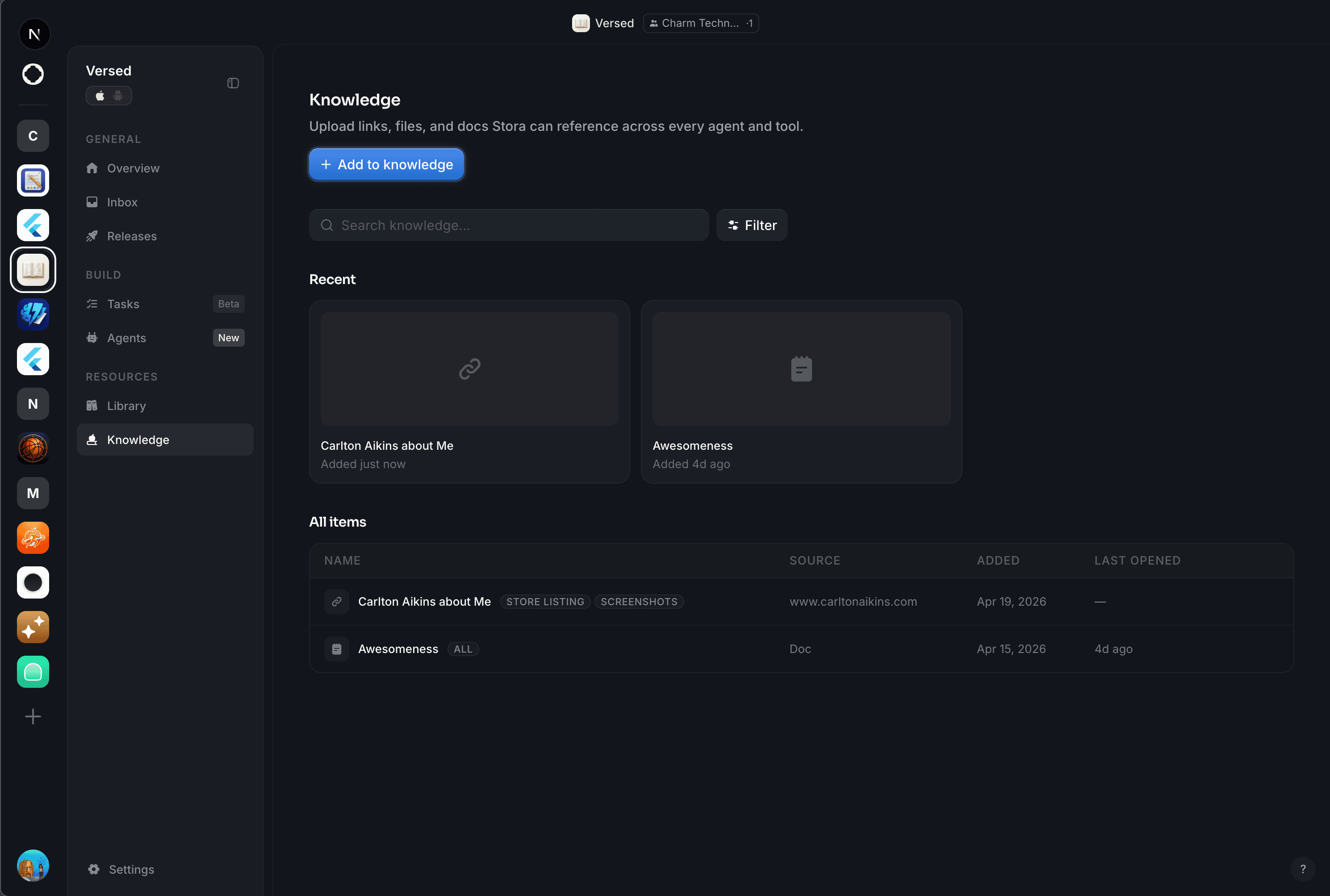
Everything you need. Nothing you don't.
Document upload
PDFs, markdown, plain text, Notion exports, Google Docs exports, Figma notes. Stora extracts and indexes the content for agent retrieval.
Link resources
Add URLs to public documentation, Notion pages, GitHub wikis. Agents re-fetch the content on each run so updates propagate automatically.
Smarter agents
Knowledge-fed agents write listings in your brand voice, catch compliance issues unique to your category, and respect the rules your team already wrote down.
Scoped access
Knowledge entries scope to project, organization, or all-apps. Sensitive docs stay on the app they belong to; shared ones propagate cleanly.
From scattered docs to agent context.
- 01
Upload or link
Drag a PDF in, paste a Notion URL, or connect a shared Google Drive folder. Content is extracted and indexed automatically.
- 02
Tag for retrieval
Add tags like "brand-voice", "compliance-history", "category-policy". Agents filter by tag rather than searching your whole knowledge base every run.
- 03
Agents read on run
When the ASO agent runs, it pulls your brand-voice entries. When compliance runs, it pulls prior rejection letters. Retrieval is per-run, not cached.
- 04
Review the trail
Every agent run logs which knowledge entries it retrieved and how they influenced the output. Auditable, reviewable, revertable.
Knowledge is what makes agents yours.
A generic ASO agent will produce generic listings. A compliance agent without knowledge of your category will flag false positives and miss category-specific rules. What turns a generic agent into a product-specific one is the context it's given. Stora's Knowledge system is the place that context lives.
Common entries customers upload: brand voice guides, prior App Store rejection letters (so compliance flags similar issues earlier), category-specific policy notes (kids, finance, health), launch rollout plans, competitor teardowns, design system notes, translation glossaries, legal-approved phrasing for privacy copy. Every one of these nudges agent output toward what your team has already decided works.
Entries can be scoped tightly — one compliance history document only feeds the compliance agent on one project — or broadly, for shared materials like brand voice that apply to every run. Knowledge updates propagate instantly; the next run picks up the new content without any cache invalidation.
Who already has the knowledge scattered somewhere.
Frequently asked.
- Can I upload source code?
- Technically yes, but for most cases the agent reads the repo directly on run rather than from Knowledge. Use Knowledge for documents, not code.
- What about sensitive docs like rejection letters?
- Mark them private — they stay project-scoped, encrypted at rest, and never surface outside their originating project. Access logs are retained for 12 months on the Agency plan.
- How large can an entry be?
- Up to 2 MB per file, unlimited entries per project on Launch and Agency. Large PDFs are chunked automatically so retrieval stays fast.
- Can I share knowledge across projects?
- Yes — org-scoped entries are visible to every project in your org. Useful for brand voice, design system rules, or team-wide policies.
Ready to ship?
Connect your GitHub repo and let agents handle the rest. Your next release, out the door in minutes.